I. The Culture Model
Reflecting on my company’s performance and growth trajectory over decades of organizational evolution, and considering current teachings and philosophies on organizational culture, I envisioned a more comprehensive model of culture. In this newly envisioned culture model, I link a culture pillar to each of the three domains of an organization: the principal executive (CEO), the organization itself, and the marketplace. The three culture pillars linked to these domains are “executive leadership,” “organizational facilitation,” and “marketplace accountability.”
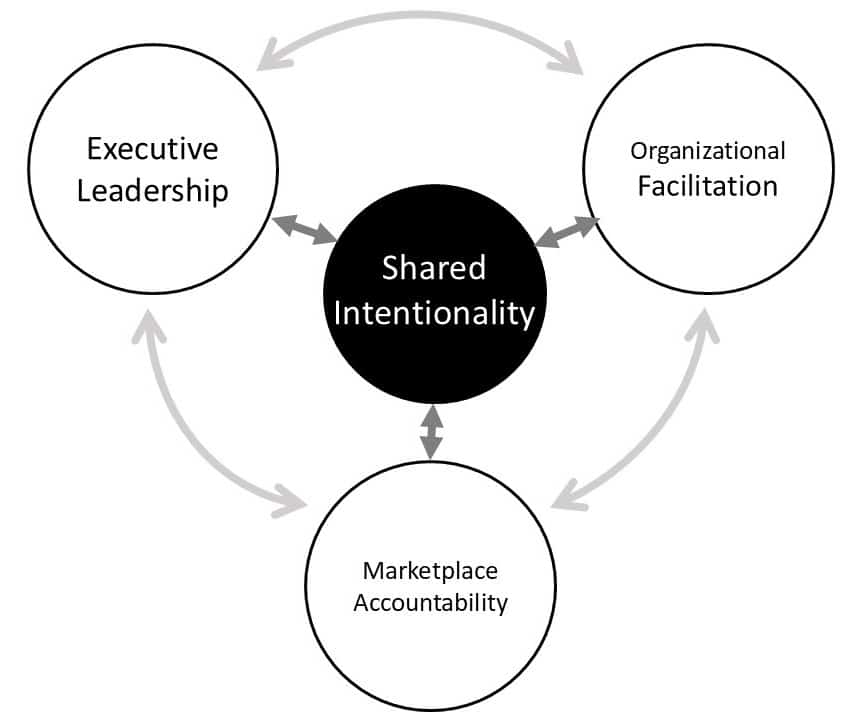
Each of these culture pillars has its own internal mechanisms for optimization, and the overall organizational culture depends on their integration. Executive leadership refers to a CEO’s (or principal leader’s) ability to influence an organization toward desired outcomes. Organizational facilitation is the mechanism for discovering, developing, and communicating values and purpose. It establishes ‘internal flow’ and is the pillar of organizational health. Marketplace accountability refers to an organization’s ability to hold itself accountable for delivering differentiated value to the marketplace – business’s core purpose.
In the culture model, each of these pillars has its own internal structure and mechanisms that enable it to perform and integrate with the other pillars. The overall effectiveness of the culture depends on the model’s integration, in which each pillar amplifies the others, producing a whole that is greater than the sum of its parts.
This article is a summary of only the ‘Executive Leadership’ pillar of my three-pillar culture model. The Executive Leadership pillar, as described in this article, is observational and emerges from reflection on my company’s historical performance, as well as a study of existing leadership models and theories. It represents practitioner-derived insight and not formal academic research. Its uniqueness lies in its focus on the mechanisms through which influence in the organization occurs rather than on how it is derived.
This approach to leadership is more pragmatic and practical for workplace application. The model is motivated by the evolution of leadership in my company and my observation that the leadership models I’ve studied have failed to fully capture my personal experience as an entrepreneur and CEO. Furthermore, my experience in studying leadership models suggests that while many of the leadership models I’ve studied effectively model leadership, not all effective leadership is modeled. In essence, there are often exceptions or outliers that remain unexplained. These models are valuable but insufficient. Many models err by conflating desirable leadership with effective leadership – these can be different objectives, producing different outcomes.
Through introspection within my company, interviews with Founders and CEOs, biographical and instructional readings, and academic articles, I’ve observed various sources of leadership power. My time in academia included working through case studies in which, as affirmation, I observed the same varied and disparate sources of leadership power among high-profile leaders who led well-known, familiar companies.
By leadership power, I mean the capacity to influence an organization toward desired outcomes. In this context, power is a source of leadership effectiveness. In my model, four primary categories of leadership serve as sources of leadership power. The observation that different leaders, comparatively, have varied and disparate leadership styles that constitute leadership effectiveness is explained by differences in category utilization.
II. Sources of Leadership Power
This leadership model considers four categories of leadership from which leaders can draw leadership power – the capacity to influence the organization toward desired outcomes. I’ve labeled these categories: Transactive, Attributive, Circumstantial, and Affinitive. I’ve defined these as follows:
Transactive Leadership: Leadership power is derived from work-related interactions between the leader and team members or followers. Here we are describing how leaders interactively engage with their employees. Are interactions deliberate or reactive? Are they compassionate or terse? These interactions are transactive because they drive or set performance in motion through interactions between leaders and those they lead.
Attributive Leadership: Leadership power is derived from the leader’s attributes. Here, we consider how the attributes of leaders, such as work ethic, courage, vision, passion, and integrity either inspire or establish credibility with employees.
Circumstantial Leadership: Leadership power is derived from the circumstances of the environment in which the organization operates. These circumstances determine the relevance (or importance) of the ‘job to be done’ by the deliverable brought to market, or the internal circumstances within the organization. Examples of circumstantial leadership include situations in which an economic crisis, a competitive threat, a societal need, or an environmental threat changes the relevance of the job to be done or affects its perceived importance. Internal examples include items that provide context for the leader such as the organization’s core values, core purpose, or the internal perception of market performance.
Affinitive Leadership: Leadership power is drawn from personal affinities between the leader and her employees. These affinities are unrelated to the organization’s objectives or core purpose. Power is drawn from shared personal beliefs, values, and intrinsic relatability.
The test for each category as a source of leadership power is whether strengthening it increases overall leadership effectiveness while the other categories remain constant. This test is theoretical, as the categories cannot remain constant and each category influences or amplifies the others. (We will explore this later in the article in the section on category integration). For example, in the Circumstantial Leadership category, it is unlikely that any particular circumstance will confer leadership power independent of the interactions in the Transactive Leadership category. However, a change in the Circumstantial Leadership category may, based on a change in consequence, amplify the baseline or existing leadership power in the Transactive Leadership category – independent of any changes in the interactions that constitute transactive behavior. The precise, unchanged interaction may provide more or less leadership power only as a result of changing circumstances, and not as a result of a change in the leader’s interactions.
Consider an example in each of the categories. For Transactive Leadership, transitioning from a reactive to a deliberate interactive style can enhance leadership effectiveness. In the Attributive Leadership category, a greater passion for business goals, a stronger work ethic, or more courageous decisions can enhance leadership effectiveness. For Circumstantial Leadership, an existential threat in the marketplace or an operating culture with clearly understood and cascaded core purpose can improve leadership effectiveness. And finally, for Affinitive Leadership, engaging in off-site exercises that foster vulnerability and transparency, or participating in higher-purpose initiatives, can enhance leadership effectiveness.
In each of these examples, overall leadership effectiveness is improved from a change in one category, independent of changes in the other categories – although changes in the other categories are an inevitable result of category interdependence, integration, and amplification.
The relationships between leadership categories are complex and nuanced. A consistent challenge to the concept has been that the categories are not distinctive, not clearly defined, and too often overlap indistinguishably in real applications. My response to this challenge is that a distinction should be made between interdependency and indistinguishability. The categories are very interdependent and require integration to optimize effectiveness. (Category integration is presented later in the document). They are also distinct and can be distinguished from each other. For this distinction, we can identify a primary driver of influence that helps define each category. These are as follows:
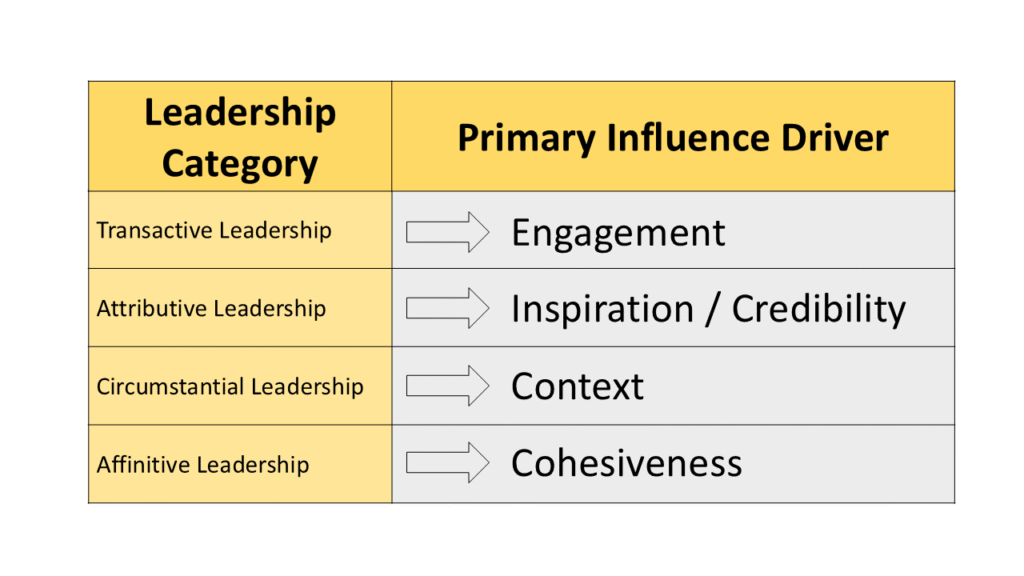
In this table, we see the distinctiveness of the categories based on the primary drivers of influence in each. While these drivers are primary, they are not exclusive of each other or exclusive to the category.
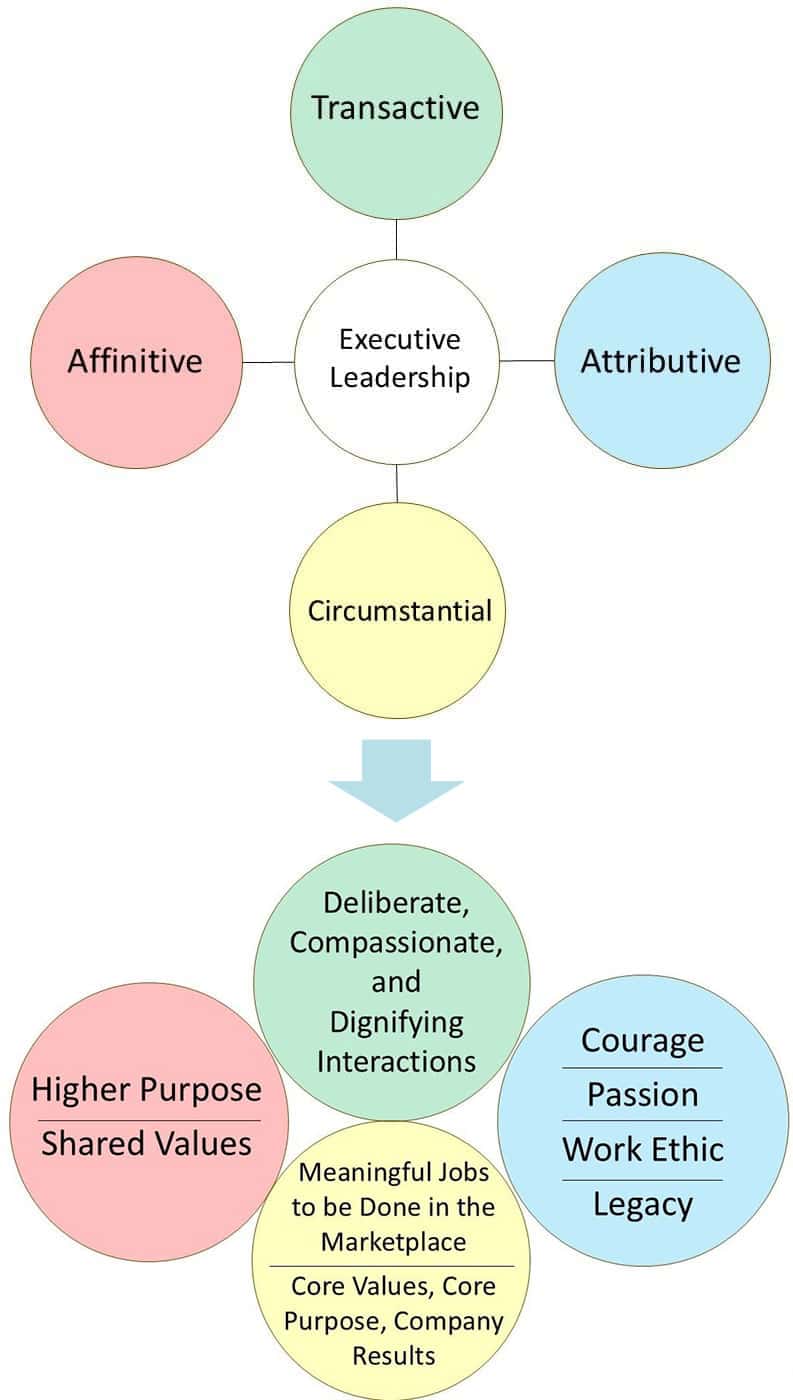
Does the leader transact with her employees in a way that fosters engagement and elicits constructive responses? This interactive style would be compassionate, deliberate, and non-reactive. In being deliberate, responses are thoughtful, constructive, and productive. Does the leader have attributes that inspire or establish credibility? These may include work ethic, courage, passion, and vision. Some of these attributes such as passion, courage and work ethic directly inspire employees. Others, such as integrity, humility, or authenticity establish credibility and function as amplifiers. Does the business operate in a set of circumstances that provide context that contributes to meaningfulness or purpose for its employees? How important is the job being done by the deliverable? What are the external threats to the job to be done? This might be a societal need or a competitive threat. How is context affected by the internal cultural environment? Is there a clear set of core values and a clear core purpose? And finally, are there affinities that present as shared ideals, values, and beliefs that foster cohesiveness between a leader and her employees? This may mean improved relatability from offsite exercises, or a collective higher purpose for the business separate from the value of its deliverables.
Category Item Examples:
Here we model executive leadership, broken out into the four sources of leadership power identified in this article. The lower portion of the graphic provides examples of important items that appear in each of the categories:
Core versus Peripheral Aspects:
Items within the leadership categories can be divided into core and peripheral aspects of the overall leadership paradigm. This division adds to the utility of the framework.
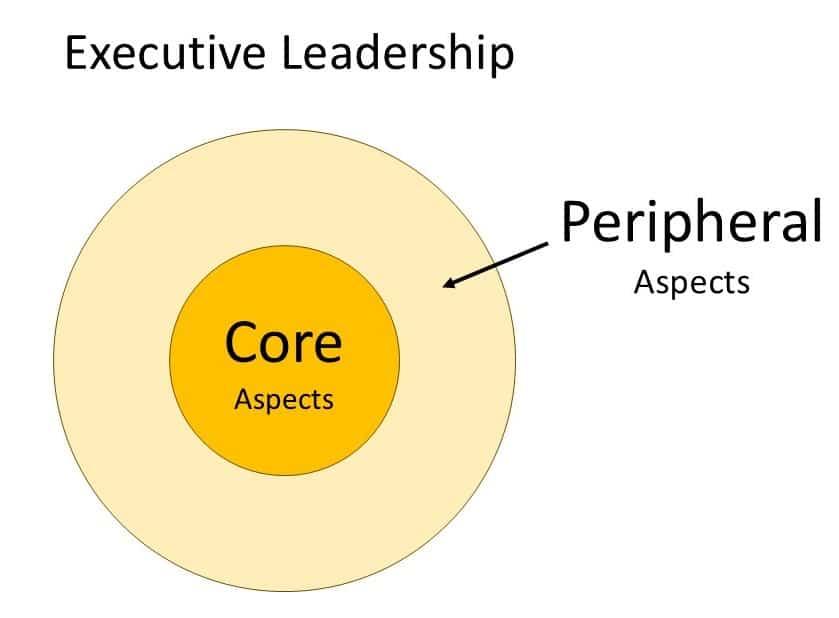
The distinction that governs core versus peripheral attributes is that core attributes are object-directed – they function in pursuit of the company’s objectives, and are within the leader’s purview. For example, vision is the company’s future, passion is the company’s purpose, mission, or goals. Work ethic is the company’s work. Courage, as presented in the article, is also object-directed. It is the courage to do the tough things that need to be done in a particular business. The courage to make tough decisions for the company – to take risks. In this context, courage is presented as a core attribute. ‘Legacy’ in this context is also object directed – it is the inverse of ‘vision,’ referencing the leader’s past role in the development of the organization. Core attributes skew more toward the inspiration side of the category. In its core application, courage is among the most important attributes for a leader.
By comparison, peripheral attributes such as integrity or humility have targeted implications within the organization, but are not target-specific in the way core attributes are. These peripheral attributes are how a leader conducts herself in the work environment and skew more toward the credibility side of the category. They are portable across different businesses or industries, while the value of core attributes is company specific.
Using these definitions, individual items in categories can be core or peripheral. In the Attributive category, the items presented in the graphic on page 5 are core – they are inspirational and directly target the goals and objectives of the business. They are object targeted and their value is company specific. By comparison, peripheral items in this leadership category would include attributes such as integrity and humility. These are positive attributes for the business, but their influence stems from credibility rather than inspiration, as they do not directly target the business’s goals and objectives. This is not to say they are less important – they are clearly very important. These ‘non-core’ leader attributes function more as amplifiers than producers of direct inspiration.
Consistent with this definition, there is also a distinction between core and peripheral circumstances in the Circumstantial category. In the Circumstantial category, the distinction is within or outside of the leader’s purview. The peripheral items in this category would be the context provided by the marketplace and include the importance of the job to be done by the deliverable. The internal circumstances of the company are core – within the leader’s purview. These circumstances provide context inside the company. Examples include internal culture, as defined by the organization’s core values and purpose, and internal perceptions of marketplace performance. Both the internal and external circumstances provide context that affects the leader’s influence within the organization. Again, the peripheral circumstances are no less important than the core circumstances.
The Core Dichotomy:
An observation within my company, consistent with other businesses with which I’ve worked, is that Founders lead disproportionately from core items in the Attributive category, and hired or professional CEOs lead disproportionately from the Transactive category. The core attributes of Founders pose a risk of subtractive items in the Transactive category. (Subtractive items are defined later in the article). Recognizing this dichotomy can make the framework especially useful for executive leadership.
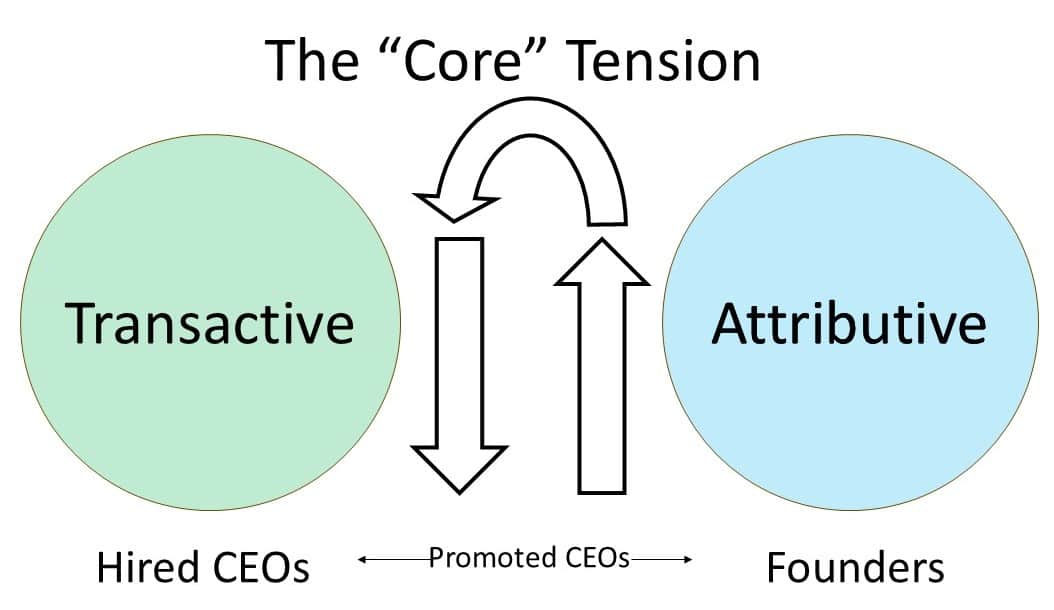
The core dichotomy makes sense for several reasons. First, transactive or interactive skills are not a rite of passage for Founders. Founders are typically entrepreneurs with a good idea that can add value to a marketplace and have the wherewithal to bring it to market. This wherewithal includes vision, passion, work ethic, etc. – attributive category items. There is nothing in this description that includes transactive or interactive skills. Second, the Founder’s emotional tethering to the enterprise often presents as insistent perfectionism or extreme passion. This can manifest as ill-temper, intolerance, impatience, and reactivity – all subtractive elements in the transactive category. As the positive attributes become increasingly manifest, there can be a corresponding degree of proportionality in the subtractive transactive elements (presented later in the article).
Interestingly, non-core attributes such as humility and integrity mitigate the dichotomy. Founders who are humbled by experience often build or recover the transactive skills that are challenged by extreme passion or perfectionism. A notable example of this would be the difference between Steve Jobs’ first stint at Apple as a Founder and his return as a rehired CEO. In his biography, Walter Isaacson describes Jobs as enormously passionate and an uncompromising perfectionist. These attributes, as described by former employees, were magnetic, but had sharply negative implications for his skills in the Transactive category.
Subsequently, author Geoffrey Cain in his book ‘Steve Jobs in Exile’ notes that Jobs was humbled by his time at NEXT, prior to returning to Apple. The newfound humility mitigated the prior negative Transactive elements.
Conversely, for hired or professional CEOs, strong transactive and interactive skills are a rite of passage. Professional CEOs are trained in these skills, and their hireability is largely dependent on their mastery of them. Further, hired CEOs are less burdened by the emotional tethering that is the Founder’s experience.
Although hired CEOs may not bring the passion and vision of Founders in the attributive category, they can still develop or discover other attributes that enhance leadership power. Conversely – and perhaps more importantly, Founders can develop the empowering transactive skills of professional managers and CEOs.
Subtractive Elements
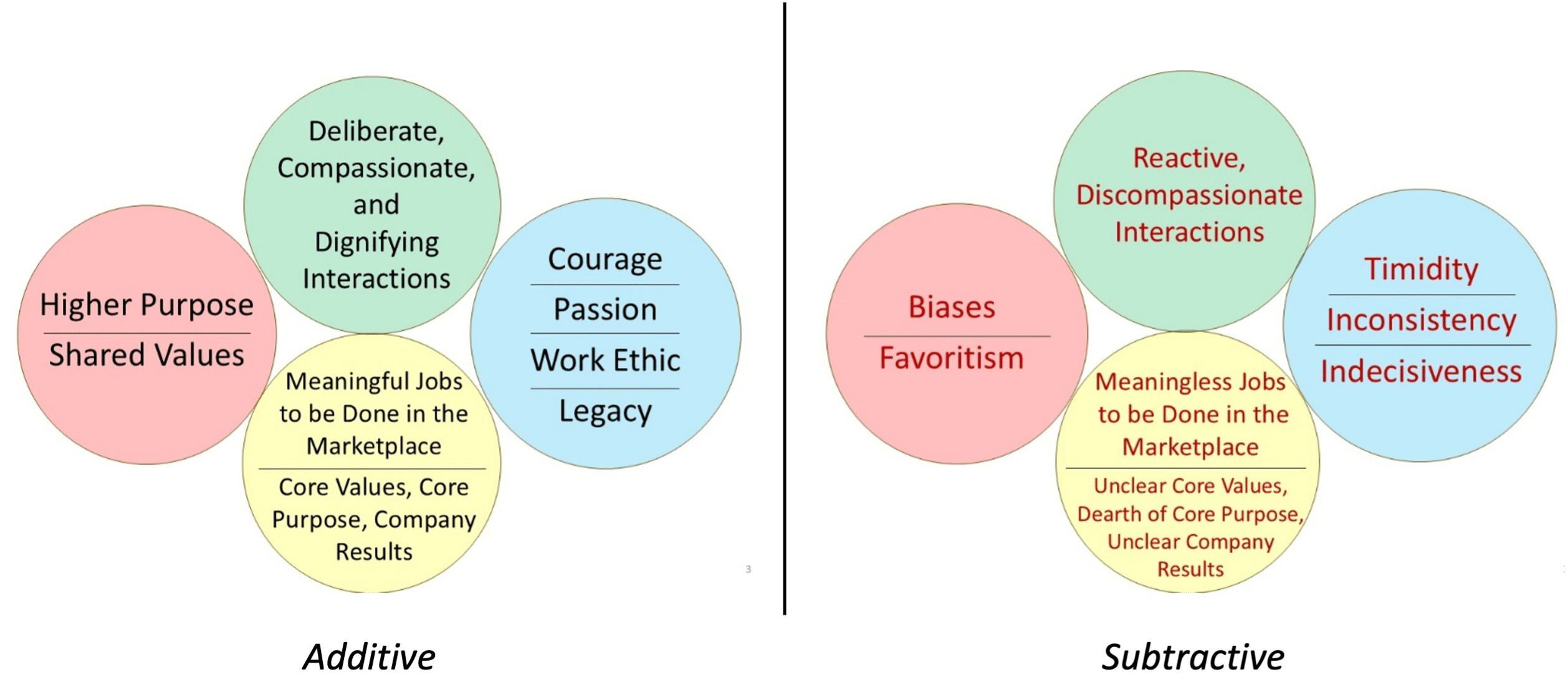
Aiding the practical application of the four leadership categories is understanding that each leadership power source or leadership category has both additive and subtractive elements. For examples of category subtractions in the Transactive Leadership category, we reference the work of researchers Robert J. Anderson and William A. Adams, as outlined in their book, “Mastering Leadership.” Based on many years of research, they demonstrate that reactive leadership is subtractive to leadership effectiveness. For executives, transitioning from reactive to deliberate leadership interactions changes these transactive interactions from subtractive to additive. In more general terms, interactions that are rooted in ego rather than humility are more likely to be subtractive, while more humble interactions are more likely to be additive. Humility is an example of amplification in the Transactive category spurred by a peripheral attribute within the Attributive category.
Similarly, for the Attributive Leadership category, unreliability, irresponsibility, apathy, or indecisiveness as leader attributes will be subtractive. These are attributes that, if present, will quash inspiration rather than cultivate it.
A uniquely interesting item in the Attributive Leadership category is empathy, as an attribute. Empathy is peripheral and can be either additive or subtractive, depending on whether or not it is checked by reason. Unchecked emotional empathy can be a subtractive attribute. (In my experience, this is a delicate area where treading lightly is prudent. A few years ago, I made a presentation on conscious leadership to a group of young, upstart entrepreneurs. I invoked the framework discussed in this article. The suggestion that emotional empathy could be subtractive to leadership effectiveness was not well received by this young, idealistic audience. The assertion was vociferously challenged, and all else in the presentation was lost to the issue.)
This isn’t to say that leaders shouldn’t care about their employees – they absolutely must care. However, it is helpful to make a distinction between emotional empathy – feeling what you feel, and cognitive empathy – understanding what you feel and why. Paul Polman, the former CEO of Unilever, and Jacqueline Carter, the Managing Partner at Potential Project, share this perspective. Both have argued that emotional empathy can be a barrier to action. My experience is that while the humanistic quality of emotional empathy is admirable, when unchecked by reason it can cloud the objectivity needed for effective leadership as well as become a barrier to action. Both of these effects are subtractive. A method for transitioning from emotional to cognitive empathy – or adding reason and deliberation to empathy- is presented later in the article.
As a peripheral item in the Attributive category, empathy amplifies rather than inspires. The amplifying effects of empathy are most evident in the Affinitive category, where it can foster cohesiveness.
A subtractive risk to Circumstantial Leadership power arises when the job-to-be-done in the marketplace is perceived as meaningless, unimportant, or unthreatened. The marketplace circumstances that determine external threats or the job-to-be-done’s meaningfulness are outside the leader’s purview (a peripheral aspect of leadership), so the remedy is to find a more meaningful or consequential deliverable. However, the leader should be cautious here because an organization must stay within its competencies and be sensitive to value chain fit, as priorities.
Internally, undiscovered or undeveloped core values and core purpose, or core values and purpose that are not effectively cascaded through the organization, can be subtractive. When an organization has not effectively cascaded clear purpose and values throughout itself, it becomes vulnerable to what Patrick Lencioni calls accidental values. These accidental values can be destructive to the organization’s culture and provide context that is very subtractive for leadership in the Circumstantial category.
An additional subtractive risk in the Circumstantial category could be embellishment or fabricating circumstances, or leveraging a circumstance by catastrophizing, exaggerating a threat, or overstating a company’s ability to address or remedy a societal need, which can yield short-term leadership benefits. However, over the longer term, these practices, which may be additive in the short term within the Circumstantial Leadership category, will be subtractive overall – notably in the Attributive Leadership category – subtracting from attributes such as honesty, authenticity, and integrity. This is a short-term addition that produces a long-term subtraction.
Subtractions in the Affinitive Leadership category pose disproportionate risks for leadership and organizations. We sometimes risk building a C-suite or developing management teams that are similar to us in comfortable but unhelpful ways, while overlooking key strengths that support organizational health and strategic growth. In my company, when we hired key decision-makers anchored in values, character, and talent—and evaluated candidates against clear role criteria—we built an extraordinary C-suite and leadership team that was also very diverse. Not allowing affinities to obscure objectivity led to measurably improved, durable, persistent returns. Further, breaches of ethics, absences of moral conscience, or malfeasance, if present, are clearly subtractive from leadership effectiveness in the Affinitive category.
Here, in this graphic, is a comparison of some examples of additive and subtractive elements in each of the categories:
III. Using the Framework
Using the framework offers two strategies for leaders to improve their effectiveness – their ability to influence the organization toward desired outcomes.
The first of these strategies is to optimize each leadership category. Here, the categories are differentiated and developed – making each category as most additive as possible and least subtractive as possible.
The second strategy is for leaders to overcome biases toward established or preferred categories that may prevent them from recognizing the value of developing other categories – the leader’s tendency to lean into one or more categories while disregarding or dismissing others. While the first strategy is optimized through category differentiation, the second is optimized through category integration. Effectively integrating the categories amplifies the overall benefit, creating a system of ‘fit’ which is greater than the sum of its parts.
The Transactive leadership category offers the most direct opportunity for integration. It serves as a conduit – a delivery system for the other categories. As such, its amplifying effects are notable. If a leader develops only transactive skills and disregards the other categories, the opportunity for amplification is lost. The same is true for the leader who focuses on the other categories and disregards the Transactive category. The opportunities for amplification, however, are not limited to this particular integration. These opportunities exist in integration throughout the categories.
Summarizing the opportunities, the categories, when optimized, provide a collection of strengths that add up to greater leadership effectiveness. Integrating the categories transitions these strengths from a collection into a system in which the ‘fit’ of items across categories amplifies the whole, making it greater than the sum of the parts.
In my company, we identified three paths for realizing these opportunities:
- Framework Utility
- Intra-organizational Development
- Intra-personal Development
Framework Utility:
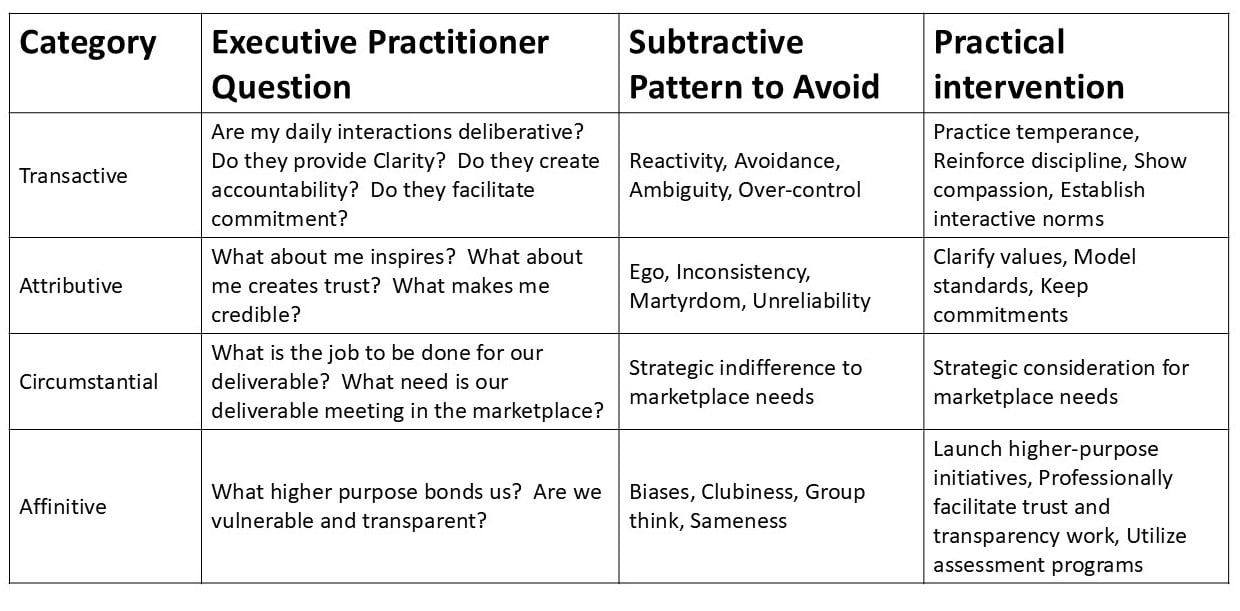
There is benefit in simply using the framework presented in this transitional chart (below) – understanding the additive and subtractive elements in each category. (The contents of the chart are suggestive and typical, but not definitive. The questions, avoidances, and interventions may vary, provided they remain within the category definition).
Intra-organizational development:
This opportunity is straightforward and disproportionately benefits Founders (as opposed to professional managers) in their leadership roles. As Founders typically draw leadership power from the Attributive category and are at risk of behaviors that are subtractive for the Transactive category (the Core Dichotomy), hiring a key executive for the organization with strong, complementary Transactive skills can provide balance or facilitate category integration. Before achieving scale, Founders often serve as a combined CEO and president, wearing many hats. With scale, there are opportunities to separate these positions and bring new executives with strong transactive and managerial skills into the executive suite. This means adding a professional manager. In this remedy, the Founder, with an abundance of vision and passion, retains the CEO position, and an executive with strong transactive and professional management skills assumes the presidency. With both parties willing to be deferential, these complementary skills and styles can improve the effectiveness of overall executive leadership within the organization.
This remedy is an intra-organizational method for addressing the ‘Core Dichotomy,’ in which Founders are at risk of subtractive engagements in the Transactive category.
Intra-personal Development:
Contemplative practice or mindful meditation can be especially productive in realizing the framework’s potential. Engaging in ‘practice’ can facilitate both category optimization and integration. Most mindful practices generally consider three types of meditation: focused attention, open awareness, and loving-kindness.
In focused-attention meditation, the practitioner sustains attention on a single object for an extended period. The breath is often the target of the attention (although external stimuli or other internal sensations can be used, as well). The effect of this meditation is to improve concentration, reduce distractibility, and strengthen cognitive control. In essence, it trains the ability to regulate attention. When focusing on the breath, the practitioner also develops a technique for situational responsive stress reduction.
In open awareness meditation, the practitioner simply observes whatever arises during a meditative session. This includes thoughts, emotions, sensations, and sounds. They are observed with complete objectivity and without judgment. This meditation trains awareness.
In loving-kindness meditation, the practitioner intentionally cultivates feelings of compassion, forgiveness, warmth, and goodwill directed at the self. The practice increases positive emotions, compassion, and social connection.
The full effect of meditative practice is broader than the scope of this article, but a shallow dive into a few of its benefits is worthwhile.
The overall benefit is that these meditations collectively train self-regulation – the ability of the mind’s executive functions to check emotions and reactivity. We call this temperance, and it is a powerful transactive leadership skill. At the same time, the practices cultivate compassion – also a powerful leadership skill. The ability of a leader to be deliberate while interacting compassionately, rather than reactive and apathetic, is a powerful manifestation of transactive leadership within this framework.
Over time and with continued meditative practice, additive attributes can emerge. As ‘compassionate’ describes a behavioral interaction in the Transactive category, it is also a peripheral leadership attribute in the Attributive category that amplifies other categories. With ongoing practice, many additive attributes are enhanced while negative attributes are diminished.
There is compelling research linking meditation to improvements in emotional intelligence[i] and a greater affinity for a higher purpose[ii]. These are cultivators of cohesiveness, the primary driver of influence for the Affinitive category.
And while we can see these optimizations within categories, there is a more profound benefit – albeit less intuitive. And this is the category integration that drives the categories into a system of ‘fit’ whereby there is amplification and a greater whole. A deep dive into this process is beyond the scope of this article – so suffice it to recognize that meditative practice is associated with improvements in ‘systems intelligence.’ The practice helps leaders hold multiple sources of influence in awareness at once and choose a response that best fits across category boundaries. Here, the leaders observe the interactions themselves, their own attributes, the market or organizational circumstances, and any relevant affinities or values. The expanded awareness allows leaders to choose a response that fits across categories, optimizing opportunities for amplification. This is integral leadership.
Concluding Thoughts
The leadership model described in this article is motivated by my personal experience as a business Founder and entrepreneur, and by my observation that many existing leadership models are inconsistent with that experience. For me, the framework within this article brings value to the discussion in the following ways:
- It demonstrates that leaders can lead in different ways, drawing on different leadership categories. This diversity in sources of leadership power helps explain the exclusions and exceptions that are unaccounted for in many existing leadership models.
- It helps clarify the need and guides Founders and entrepreneurs, as business leaders, to develop skills within the Transactive Leadership category to pursue overall leadership effectiveness.
- It provides a visual for category integration and an understanding of amplification across category boundaries.
- It provides three useful strategies for leaders to improve effectiveness within each category and then amplify results across the categories.
Much of the current narrative on leadership conflates desirability with effectiveness. As much as we would like it to be, these are not necessarily the same. Business leaders can lead effectively in different ways, drawing on the leadership power from each of the four categories described in this article. Although my experience is observational, different leaders have natural leadership styles that draw disproportionately from one or more of the categories. Founders and entrepreneurs more often draw disproportionate power from the Attributive category, and sometimes subtract from the Transactive category. Professional CEOs and managers more often draw power from the Transactive category, and in doing so, amplify the attributes in the Attributive category.
In my company, when we integrated categories – both intra-personally and intra-organizationally – the results were profound. The path to leadership effectiveness is not to pigeonhole leaders or leadership into a single category, as many models do – but rather to work toward category development and integration, where the fit of the items across category boundaries will create a whole that is greater than the sum of its parts, the result being an integral optimization of leadership effectiveness.
IV. Addendum
Challenges to the Model:
1. Category Ambiguity – In discussions and workshop presentations, one critique of the model is that the categories are (in some applications) ambiguous. This critique inspired the addition of the primary driver of influence to each category. Deeper conversations regarding perceived ambiguity have revealed the need for more clarity around the mutual dependence, interrelatedness, and integration of the categories. These are acknowledged in the document as not only intrinsic to the model but also a primary feature of its benefit.
I’ve attempted to address this issue in the document by recognizing reader conflation of interdependence and indistinguishability. The categories are clearly interdependent and interdependently amplified – and changes in one category will always affect other categories; however, they remain distinguishable and have different influence drivers.
2. Model Comprehensiveness – Within the body of feedback, there has been a challenge that the model omits a ‘legitimate leadership’ category, which would include items that legitimize leadership as a source of power. This challenge is inspired by the work of French and Raven in their 1959 study of social power.
In the model presented here, legitimacy as a form of leadership power is considered and embedded within the existing categories, and repeating it as a separate category would be redundant. Where legitimacy lands in the model is determined by whether its source is within the leaders’ purview or outside of the leader’s purview – core or peripheral. For example, if a leader is legitimized by virtue of a hierarchical cultural norm that reveres position or title, the power would fall into the Circumstantial category. The norm would be a circumstance outside the leader’s purview. Legitimacy derived from track record, legacy, reputation, etc. would fall within the leader’s purview and reside in the Attributive category. The leader’s attributes would be the source of legitimacy as influence.
In both examples, the source of legitimacy would determine its category, and legitimacy itself would be an element within that category – not a category itself.
Leading with Higher Purpose:
Because of its importance, I provide further elaboration on the Affinitive category’s higher purpose here, in the article’s addendum.
A higher purpose and moral conscience can enhance leadership effectiveness in the Affinitive Leadership category. This improvement in the Affinitive Leadership category presents an opportunity for amplification across all categories, resulting in a level of effectiveness that exceeds the sum of the individual leadership categories.
I teach my students that the core purpose of business (collectively) is to add value to the marketplace. It follows that the core purpose of a company (individually) is the unique or distinctive way it adds value to its marketplace – or the unique and distinctive (differentiated) value it adds to its marketplace.
I believe that companies should grow from a commitment to purpose rather than merely from a quest for financial gain. However, the commitment to purpose must translate into differentiated value for the marketplace. A company must differentiate itself.
For core purpose, we define value as the job to be done and how well the company does it. This definition is crucial, as it is the purest measure of a company’s sustained viability. Without doing this, businesses can do little else. At the same time, I describe core purpose alone as ‘insufficient.’ Company leaders must also foster higher-purpose initiatives and values within their organizations. While core purpose provides differentiated benefit as value to the marketplace, higher purpose provides affinity value. The total value brought to the marketplace includes both the differentiated benefit of core purpose and the affinitive value of higher purpose.
The conscious business community often argues that there should ‘necessarily’ be no distinction between core purpose and higher purpose – that they are the same. I’ve debated this and disagree with the assessment. There can be no distinction, but this depends on the industry, company, and deliverable. The leadership categories in this framework offer a deeper understanding of the value of a company’s higher purpose, which may differ from its core purpose.
Research[iii] demonstrates that companies that engage in higher-purpose causes and initiatives, demonstrating moral conscience, can experience improved company performance, even if the higher purpose is separate from and distinct from the company’s goals and objectives. This enhanced performance is attributed to the moral conscience within executive leadership. It serves as a testament to the additive power of leadership in the Affinitive Leadership category. Here, there is a natural humanistic affinity for this type of leadership that can be distinct from, and separate from, the company’s goals and objectives. Higher purpose as a moral obligation for business, while simultaneously yielding higher performance, is evidence of an organizational (and marketplace) affinity for it. In summary, while the Affinitive Leadership category has the potential for subtractive elements, it can also serve as a powerful amplifier in category integration when company leadership embraces a higher purpose as an expression of moral conscience.
© 2026 Steve Freishtat
[i] Effect of Meditation on Emotional Intelligence and Perceived Stress in the Workplace: A Randomized Controlled Study, NIH PubMed Central Laurent Valosek, Janice Link, MA, Paul Mills, PhD, Arthur Konrad, PhD, Maxwell Rainforth, PhD, and Sanford Nidich, EdD October 29, 2018
[ii] Impact of Meditation (SRMS) on Spiritual Intelligence: An Experimental Study, Journal of Medical Science and Clinical Research Basant Ballabh Pandey, Rita Pandey March 3, 2017
[iii] How can businesses benefit from having a higher purpose? WashU Magazine Anjan V. Thakor April 9, 2021
